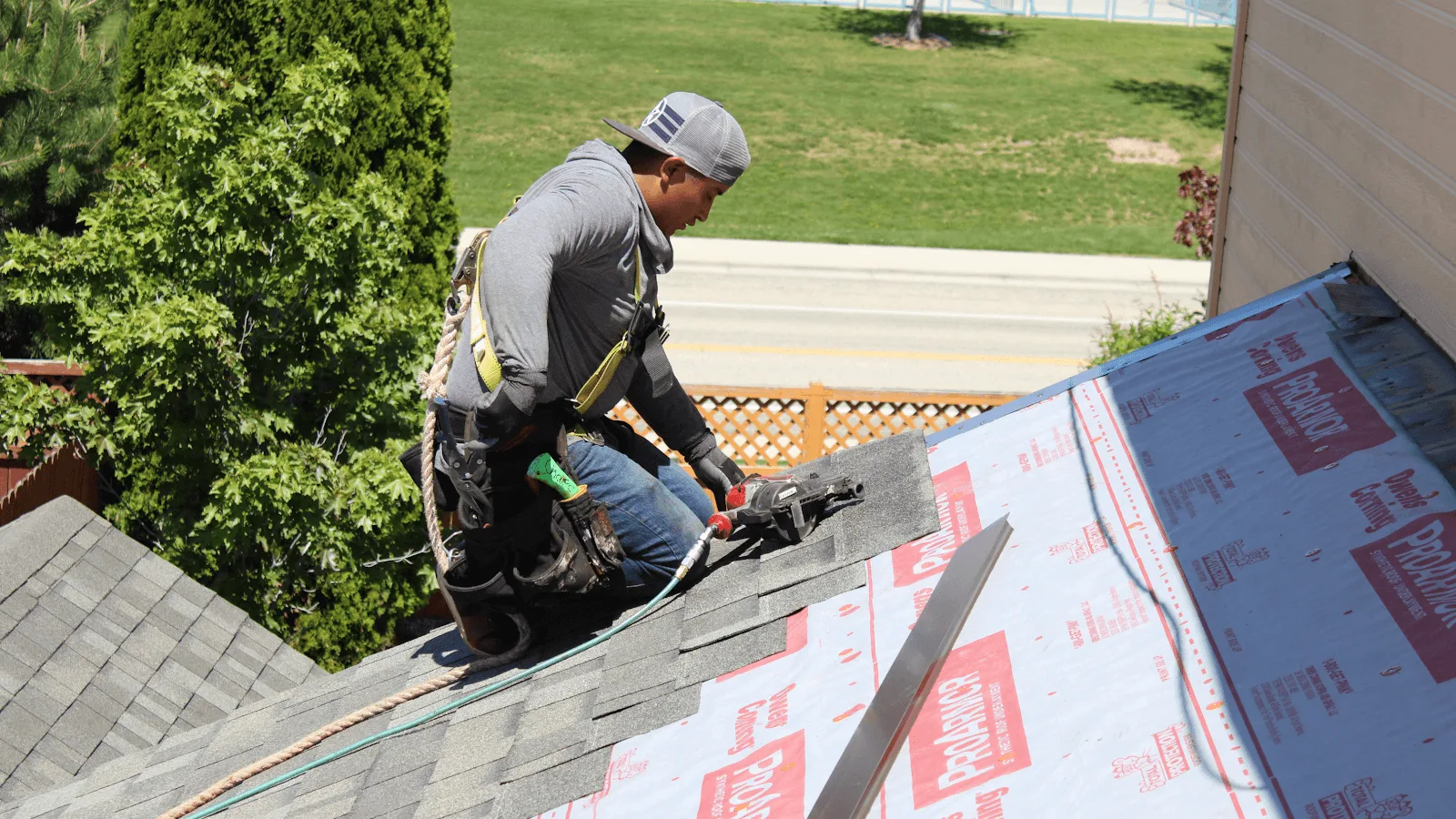
Roof Repair in Castle Rock, CO, Without the Upsell
Not every Castle Rock roof needs replacing, and a repair company that starts every conversation with a re-roof pitch is telling you something about its incentives. Wind-lifted shingles along Founders Parkway, a nail-pop leak in a Meadows two-story, cracked pipe-boot flashing on a Plum Creek ranch: these are repairs, they are common here, and done properly they buy years. This page covers what we repair, how Castle Rock's rules treat repairs, and how we decide, honestly, when repair stops being the right answer.
- Leak diagnosis and repair. Water rarely shows up under its entry point. We trace from the stain to the breach: flashing, valleys, penetrations, or hail bruising that finally wore through.
- Wind damage. The Palmer Divide funnels serious gusts; industry code summaries cite a 115 mph design speed for the town under the prior code cycle. Creased and lifted shingles lose their seal even when they do not blow off, and resealing or replacing them early prevents the leak that follows.
- Flashing, boots and vents. UV at roughly 6,224 feet cooks neoprene pipe boots faster than the flatlands. Cracked boots are one of the most common leak sources we find on 1990s-2000s builds in Founders Village and Castlewood Ranch.
- Ice-dam damage. Freeze-thaw cycling at eaves and valleys is a design condition in this climate, which is why the IRC ice-barrier provisions matter. We repair the damage and fix the ventilation and insulation contributors where access allows.
- Storm-response tarping. Emergency dry-in to stop active interior damage while a scope or claim is prepared, mechanically fastened and documented for the carrier.
- Gutter and drainage-adjacent fixes. Overflowing or detached gutters back water under the first shingle course; we correct the roof-edge side of the problem and flag the rest.
Full replacements always do. For small repairs, the Town's published Re-Roof Checklist addresses replacement, and we did not find a published square-footage exemption for repairs, so we confirm with the Building Division when a repair is large enough to be borderline rather than guessing. That is the honest answer, and it protects you: unpermitted work that needed a permit surfaces at resale, and Castle Rock's rules on registered contractors apply either way.
Watch for this after storms: door-knockers who offer to "handle everything" without a Town registration. Castle Rock states it is unlawful to have work done by unregistered and unlicensed contractors. Verify before you sign anything, including with us.
We use three tests, in writing:
- Extent. Isolated damage on an otherwise healthy roof repairs well. Widespread hail bruising across slopes, documented against NOAA-scale events like the 2.50 inch stones of June 8, 2019, usually means a claim and a replacement serve you better.
- Age and condition. Granule loss and sealant fatigue at this altitude accelerate after mid-life. Repairing a roof in its final years can be money spent twice.
- The deductible math. With Colorado wind-hail deductibles commonly $2,500 to $10,000 flat or 1 to 5 percent of dwelling coverage, a modest repair often should not become a claim at all. We price the repair so you can compare it against your deductible like an adult.
When the numbers favor repair, we repair. When they do not, we show you why, with photos. Either way you get a documented condition report you can keep for insurance or resale.
Repair pricing depends on access, pitch and materials, so we quote after inspection rather than publishing made-up flat rates. What we can promise: itemized scopes, matched materials (down to checking HOA color requirements in neighborhoods like The Meadows), and no surprise line items. For context on full-roof numbers, see the cost guide.
When a storm opens the roof, the order of operations is: stop the water, document everything, then scope calmly. Our emergency response is a proper dry-in, woven synthetic tarp mechanically fastened, not a blue sheet and prayer, plus dated photos of the damage before and after cover. That documentation matters twice: it protects your interior claim, and it preserves the evidence an adjuster needs to see. Emergency work is priced as its own small scope so it never becomes a lever to force the bigger job on you.
- Spring: post-winter check of boots, flashings and any lifted tabs; clear valleys and gutters of winter debris before hail season arrives.
- After any hail corridor: documented inspection within two weeks, even when the roof looks fine from the driveway; bruising does not read from the ground.
- Fall: gutter and valley clearing after the cottonwoods and pines drop; a quick sealant check at penetrations before freeze-thaw begins.
- Any season: interior ceiling stains, daylight in the attic or granules collecting at downspouts are same-week calls, not spring-list items.
Every repair we complete ships with its own paper trail: what failed, what was installed, and photos before and after. In a market where Castle Rock's median home value runs near $700,000, that file earns its keep at listing time. Buyers' inspectors flag roofs without history; a folder of dated, documented repairs answers the objection before it costs you a price reduction. It also protects you at claim time, because an adjuster who sees maintained flashings and documented repairs reads the rest of your claim more charitably.
The repair visit is also a code visit. While we are on the roof we note ice-barrier gaps, ventilation problems and wildfire-code items that would affect a future re-roof, so your next big decision starts with a map instead of a mystery.
The visit starts on the roof, not at the kitchen table. We trace the problem physically, photograph what we find, and only then talk numbers, because a repair diagnosed from the driveway is a guess with a price tag. You get the finding in plain terms: what failed, why it failed, what fixing it involves and what it costs, as a fixed figure for defined work rather than an hourly meter. Small repairs often happen the same visit if the material is on the truck; anything needing matched shingles or flashing fabrication gets scheduled, usually inside the week outside of storm surges. When a storm wave has the whole town calling at once, active leaks jump the queue and we say so honestly to everyone else.
The hardest part of a good repair is often invisible in the quote: making the patch disappear. Production builds in Founders Village and Castlewood Ranch carry shingle lines that may have been discontinued or re-colored since installation, and even a perfect line match reads differently next to shingles that have weathered a decade of altitude UV. Our order of preference: match the exact line and color from supplier stock; if the line is gone, match profile and blend color against the weathered field, judged on the roof and not in a catalog; and on prominent slopes where a visible patch would hurt the house, we say that plainly before you spend the money. HOA color rules in the master-planned neighborhoods apply to repairs as much as replacements, and a repair that triggers a compliance letter is not a repair that saved you anything.
A slow leak in Castle Rock does not stay slow. Water that enters in a July storm sits in the deck through fall, then freeze-thaw cycling goes to work: each freeze expands the wet wood and each thaw lets more water into the widened path. By spring, a flashing gap that would have been a modest fix is delaminated decking, and insulation matted below it, none of which shows from the street. The arithmetic favors speed: the gap between a minor repair and a deck-and-interior project is usually one winter wide. Ceiling stains, granules collecting at downspouts and daylight in the attic are same-week calls, and a same-week repair is almost always the cheap version of the story. Start with a free inspection or call (720) 796-9661.